### A Clash of Perspectives on College Campuses: A Tale of Accusations and Denials
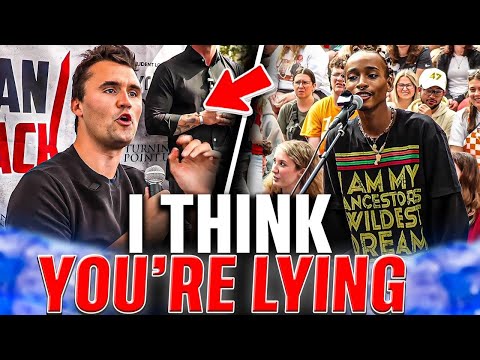
In a world where opinions clash and ideologies collide, a recent incident at a university campus has once again ignited a heated debate about free speech, racial tensions, and the experiences of students in today’s political climate. At the center of this story is Jaden Clark, a student whose account of alleged hate crimes sparked a confrontation with a conservative commentator. This encounter was anything but ordinary, showcasing the widening rift between differing viewpoints in America.
The scene unfolded when Jaden Clark, a freshman, took the stage to share harrowing experiences involving alleged hate crimes he faced on campus. Four incidents in one night reportedly involved individuals who identified as Trump supporters, with accusations of racial slurs and even threats surfacing. Clark’s narrative was laden with emotions, as he expressed feeling targeted and fearful during his time on campus. However, the backlash was swift and pointed from the commentator, who questioned the validity of Clark’s experiences.
One key moment that stood out was the commentator’s insistence on evidence. Instead of acknowledging the pain reflected in Clark’s words, there was a challenge to produce tangible proof—like security camera footage or police reports. This skepticism simmered beneath the surface, reflecting a broader culture where personal accounts can sometimes be dismissed as fabrications if they don’t align with the listener’s beliefs. The commentator’s incredulity raised questions about accountability and the expectations placed on victims of hate crimes to prove their truth amid a digital age that often demands receipts.
The debate took an interesting twist as Clark expressed his feelings of alienation and fear on campus, characterizing it as an environment filled with “vitriol and hate.” In a bid to connect with the audience, he urged them to recognize the danger of societal divisions, particularly when it comes to generalizations about groups of people. Alas, his comments were met with resistance, drawing a line in the sand where accusations of racism and hate collided with claims of political deceit. It was a stark reminder of how quickly conversations can spiral into accusations of one side being dishonest or oversensitive.
As the exchange between Clark and the commentator heated up, so did the stakes of the issue at hand. The commentator’s challenge to report the incidents to authorities was more than just a practical step; it was a call to action that hinted at a distrust of the narrative being presented. This dynamic exemplified a common theme in contemporary discussions: the dualities of belief and disbelief, supported by the broader context of cultural wars that define much of today’s political climate.
This clash was not just about one student’s experiences; it hinted at an ongoing struggle for truth and perspective in a world where fear, anger, and division often take center stage. It raised questions about the avenues victims have for seeking justice and acknowledgment while also prompting reflection on how society reacts to such serious claims. The divide between the apprehensions of students and the skepticism of conservatives is more than just a debate—it’s a profound reflection of the current state of American discourse, bubbling with emotions, aspirations, and an urgent need for understanding on both sides.
In the end, the confrontation served as a reminder that in a nation of diverse viewpoints, navigating the complex landscape of race, politics, and personal experiences will continue to be challenging. Whether individuals believe in Clark’s story or not, one fact remains clear: it is essential to foster an environment where victims feel they can share their narratives and where dialogue can happen—preferably with an open heart and an open mind. After all, understanding each other begins with listening, and perhaps realizing that in a world so divided, there is more that unites us than pulls us apart.