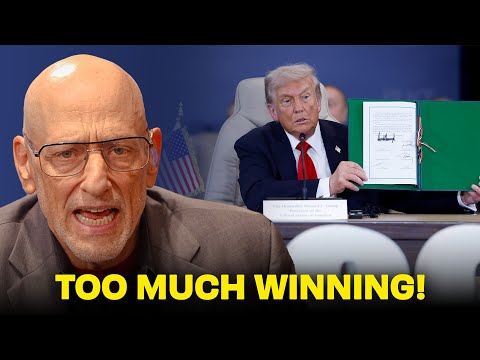
In the swirling carnival of modern politics, where everything is exaggerated to the extreme, President Trump’s recent handling of the Iran-Israel conflict has paraded him through the streets of global admiration. Whether it’s the release of hostages or the fine-tuning of international affairs to stave off the advances of China, Russia, and other villainous forces, Trump appears to be standing tall—as grand marshall of this chaotic parade. Meanwhile, his adversaries seem to be clutching at straws, planning their resistance in corners where even the janitors forget to mop.
On the sidelines, highbrow magazine editors from across the urban expanse of Manhattan are vowing that First Lady Melania Trump will never adorn their glossy covers—a resistance that surely has everyone quaking. Beyond the satire, it’s a trivial act of defiance in the grand scheme of things, but amusing nonetheless. Who knew that choosing who graces a magazine cover has turned into a battle to save culture as we know it? While Trump maneuvers global peace, some are busy deciding which celebrity’s fashion choices can clearly define our times.
In the city of angels, or at least what’s left amid the ruins of ignoring water wisdom, the fanatic few behind Jimmy Kimmel have their gaze unfalteringly set. Their loyalty declares that Kimmel’s enterprise of comedic conformity is far more pivotal than any Middle Eastern diplomatic victory. One might suspect their dedication to laughing at pre-approved punchlines is vital to the national dialogue, or perhaps it’s just another excuse to avoid reality for an hour every night.
Meanwhile, The New York Times, once the herald of truth, keeps its steadfast march to catch the public eye with headlines that are as misleading as they are amusing. Now, while catchy headlines are like today’s equivalent of shiny objects, not even their Wordle vocabulary can distract from the larger truths unfolding. Alas, their hope to unravel the administration through persuasive narratives might just meet its match in America’s infatuation with puzzles and word games.
The professors and intellectuals have not retreated either. Despite prior attempts to topple Trump with accusations that evaporate on closer examination, they continue undaunted, finding new parallels to dubious historical figures with alarming regularity. Their battle cries echo through hallowed halls where the discussion is as much about who listens as who speaks. Ever hopeful that another comparison to history’s despots might just do the trick, they persevere, knowing that the power of persuasion lies not in correctness, but consistency.
In this vibrant melee, Trump strides ahead, savoring the irony. His opposition seems entangled in their own webs of irrelevance and irony, while tales of political intrigues unfold. Perhaps history will remember this as the era when politics turned into a comedy of errors, with characters as colorful as a circus, and spectacles more dazzling than the halftime show. In the end, whoever laughs last might just win the day, or at least get the front page.