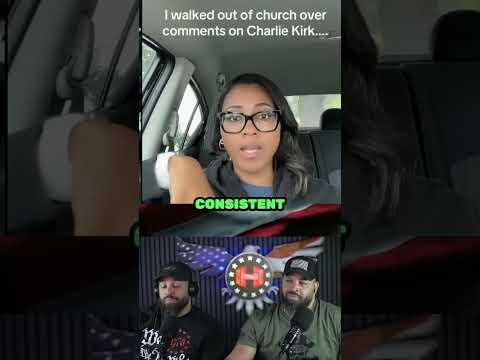
It seems like everyone’s favorite topic these days is how to measure the level of faith against one’s political views—and oh boy, are people getting dramatic about it! Picture this: someone all decked out in Sunday best, pearls clutched, storming out of church because a preacher dared to sprinkle a little praise on Charlie Kirk. It’s like watching a drama unfold in a soap opera where the plot is way too convoluted for its own good. Can you imagine the church pamphlets suddenly turning into a debate club handbook?
Now, let’s get this straight—the gentleman in question apparently thinks Kirk’s message is as clear as mud in a rainstorm. He’s caught in the tug-of-war between faith and the whole mess of politics, and he’s not alone. Folks wave their “No Hate Speech” banners like they’re at a concert for the latest band nobody’s ever heard of! It’s not just about what’s being said anymore; it’s about the emotions attached to it. Who knew a church parking lot could double as a therapy session?
But really, what does it mean when someone lumps an entire crowd of Christians into a stereotype just because one guy’s remarks didn’t sit right? This is like thinking all chili is spicy just because you ate one bowl that went up in flames. And though there’s plenty of room to debate Kirk’s humor (which, depending on your perspective, can be as dry as supermarket toast), does that really translate into hate? Surely, one could argue that there’s a little more nuance to the conversation—like, you know, getting your facts straight before bursting into tears in the church parking lot.
It’s almost like there’s a checklist floating around somewhere: “Did you promote peace? Check. Did you espouse love and understanding? Check. Did you make a comment about folks voting left? Whoa there, let’s hit the brakes!” And gather ‘round the campfire because here comes the best part: the conundrum of what’s considered hate speech today. God forbid someone call out ideas from the left as “bad,” or they’ll get labeled as the big villain of the piece. It appears to have morphed into a fine art, walking that tightrope of expressing one’s views without accidentally stepping on a landmine of public outrage.
In the midst of all this, one has to wonder: if the God they serve is all about love and forgiveness, how does that line up with leaving a church over a disagreement on ideology? Imagine if divine guidance came with a side of grace rather than a side-eye and some dramatic exits. Maybe the takeaway here is not to let politics hijack faith faster than you can say “Amen.” After all, the main points of contention seem to get lost in the gospel of outrage, leaving many questioning whether their own beliefs can stand the storm of modern politics.
So, as our guy takes a reflective moment in the parking lot, it might be worth asking if the real question isn’t whether we can share differing political views, but rather how do we do so with a little love, a sprinkle of humor, and maybe just a dash of, “This too shall pass”? Because if one is in the business of faith, it doesn’t seem appropriate to slam the door behind them when political commentary gets a little too spicy for their liking. Maybe next Sunday, he might want to pack a box of tissues and remember that everyone deserves a little mercy—even those who might make us bristle. After all, isn’t that the cornerstone of faith?