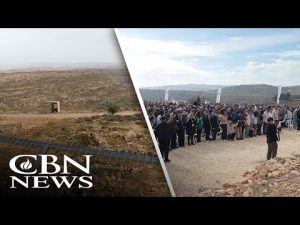
In a land steeped in biblical history, the duality of its name reflects the deep-seated conflict over identity and sovereignty. The region known by many as the West Bank is, for those who hold fast to the scriptures and the lineage of faith, Judea and Samaria—the heartland of the Jewish people and a crucial territory in God’s plan. Recently, over one thousand pastors and Christian leaders gathered in ancient Shiloh, where God’s presence once dwelled, to affirm their support for Israel’s rightful claim over this sacred land. This assembly was not merely a show of solidarity; it was a powerful message directed at the current administration concerning the sovereignty of Israel in this biblically significant area.
Dr. Mike Evans, a notable figure in the movement supporting Israel, called upon the principles that have defined both America and the biblical narrative. He reminded the gathering that the land promised to the Jewish people has divine roots and is integral to the faith that many Christians hold dear. The stance taken by some international leaders against Israeli annexation of the West Bank is seen as a contention against the very principles that resonate with evangelical values. For many in the Christian community, the ownership of Judea and Samaria is not just a political issue; it is a divine mandate that aligns with their understanding of scripture and the roots of their faith.
The leaders present at Shiloh spoke of the tremendous spiritual power of the land. They emphasized that the very ground beneath their feet was once the headquarters of worship for God’s people. This connection to history invigorates their mission to develop the area as a place of prayer and reflection. For the evangelical community, the significance of praying over and developing this land is intertwined with their belief in God’s promises to Israel.
Emotions ran high as attendees like Pastor Rusty Nelson sensed a divine presence in Shiloh, recalling the spiritual importance of the region. The gathering serves as a transformative moment not only for the attendees but also for the broader evangelical movement. Observers noted that it marked a turning point in their efforts to reclaim the narrative surrounding Judea and Samaria, shifting the discussion away from political terminology toward a recognition of the land’s biblical identity.
With the spirits of worship and historical remembrance at the forefront of their message, the hope is that their voices will resonate far beyond the hills of Judea and Samaria, reaching policymakers even in Washington, D.C. There is a collective aspiration among the gathered leaders that the sanctity of this land will not only be acknowledged but embraced as part of a larger, divine mission. As Christians and Jews unite to advocate for Israel’s sovereignty, they embody the belief that the act of supporting this land is also an act of faith and obedience to God’s will. This powerful moment in Shiloh reveals a pivotal chapter in the ongoing narrative of faith, identity, and the pursuit of justice as it intersects with one of the most contested regions in the world.